

Aligning AI to Animal Welfare
June 23, 2026
March 24, 2026
Over the past two decades, a relatively small group of advocates played a crucial role in reshaping the supply chains of major global corporations. They secured commitments affecting billions of animals – pledges to eliminate eggs from caged hens, phase out the use of fur, and move away from some of the cruelest practices in industrial farming.
The changes have been very significant, and for outsiders, it may be hard to believe that all this could be achieved by so few people with such limited resources. But I have to believe it, because I was part of it. I was sitting in corporate rooms and on online calls, creating public campaigns, and getting the media interested in the topic. Together with colleagues across the world, we dug in and insisted on achieving changes that wouldn’t just come on their own. Many approaches have been taken to exert influence on companies. I would like to share mine.
Working to influence corporations has taken place in the animal protection movement for decades. One of the first movers was Henry Spira. He successfully campaigned against animal testing at major corporations like Revlon and Avon, pioneered the strategy of using shareholder resolutions and public pressure to push companies toward adopting more humane practices, and is widely regarded as one of the most effective animal advocates. Peter Singer dedicated a book to him and made a documentary about him. Lewis Bollard said that our movement owes our current victories to him. Spira was a proponent of pursuing real, measurable change through credibility-driven engagement and always prioritizing what actually works over what he would like to work.
Henry Spira’s accomplishments were followed by a successful campaign, mobilizing numerous organizations, to convince fashion companies to ditch fur. Then, over the last decade, the most prioritized effort has been the campaign aiming to get hens out of cages. This work has seen a lot of success in the US and Europe. I have been involved in both of these initiatives, but in the last 8 years, my main focus has been working to stop the use of ultra-fast-growing chicken breeds and provide the animals with better conditions in the barn.
So, are we actually winning for animals? The answer is not simple. Securing a corporate commitment is nothing if the company doesn’t implement it. This is the confusion I often encounter when talking to people both outside of and within the movement. Holding companies accountable is often the biggest task of this line of work. Empty promises don’t help any animals.
It’s no secret that in recent years we have seen too many companies not living up to their word. To put it diplomatically, this is a challenge. I think we, as advocates, are prone to fall into the trap of believing things are in a better shape than they actually are, which is not helpful for our mission.
Furthermore, there is a misconception about how animal advocates work – by definition, only the visible work is seen, but the sweat, tears, and failures are less available not only to the public eye but also to many colleagues who are not deeply embedded in the day-to-day work with corporations.
This lack of understanding of how the ecosystem looks is worrying to me. New advocates or donors have overwhelmingly distorted views on how things are achieved – a big chunk sees only so-called “bad cop” campaigns. By this, I mean activists doing the hard work of protesting in the streets, launching targeted public campaigns, or openly attacking people at the top of companies. But there is less understanding of negotiation and finding common ground with companies.
My goal for this post is to explain how change happens and why I consider one of the approaches superior to others – an approach we in Anima International dub “fair game” or “fair cop”. I hope this will help you to be better in your work for animals – or show me the weaknesses in my reasoning, so I can be better.
Note: I will be talking about working with companies, as this is what I specialize in. But the approach also applies to other areas of advocacy. For example, it is with the fair cop mindset that we successfully worked to achieve a legislative ban on fur farming in Poland.
![A nighttime street protest march against the fur fashion industry. Demonstrators carry torches and banners, including one reading "NEJ TIL BLODIG MODE / Boycott [Valenti...]" (Danish for "No to Bloody Fashion / Boycott...") and another large black banner displaying a graphic image of a skinned or injured animal alongside the text "ENJOY THE SHOW."](https://anima-international-backend-prod.s3.eu-west-3.amazonaws.com/animas_fakkeloptog_mod_pels_2012_8192391279_l_f90d2f8317.jpg)
In general, the approaches and skillsets required to consistently move companies to improve animals’ lives seem largely underdeveloped. To help advance this line of work, I would like to share where I have gotten to after doing it for more than 15 years and why I believe that “fair cop” is often the best way to achieve progress for animals.
When I first started working with companies to improve their animal welfare standards, I was clueless. What should I say? Will the company agree? Am I wasting their time? Luckily, my colleague Joh Vinding had more experience, and by observing the way he did the work, I could take inspiration and start building my own approach. I think I’ve gone through different phases: being factual about the issue at hand, handling objections, debating, being tough, being nice, and so on.
Through trial and error and perhaps a quest to build more self-confidence, empathy, and authenticity, my approach has matured. I have a strong desire to win, and in a sense, I see the work as some kind of game. I’m a bit of a nerd myself, and I’ve spent thousands of hours playing poker, backgammon, and chess at a competitive level. If you want to be good at these games, you need to be a strong observer. You need to read the room. You must be able to see things from your opponent’s point of view. You have to play the long game and appreciate every little step forward, and not see it as a game of playing heads or tails. And you have to be realistic about your odds when you are the less powerful person in the room, which is more often the case than we would want. After playing hundreds of games, you start seeing patterns, and from these patterns you can develop your intuitions. The same goes for working with corporations.
A large retailer had had a cage-free commitment for years. We had praised them publicly several times. Suddenly, the company changed its tune, and it slowly became clear to us that the scope of the commitment had been changed significantly.
This would be a huge step back for cage-free progress, as it could set a precedent for other companies. We were polite and encouraged the company to meet with us and discuss the situation. They dodged these proposals, even after they were put forward in writing six times over a short period of time. We kept encountering strangely worded messages. It felt almost like trying to decipher ancient stone tablets. It was clear that something was fishy.
We decided to escalate our communication. We pointed out how we had praised the company publicly – backed up by a long document with collected mentions – and how the company was now breaching its own policy, which risked turning into a big reputational headache if made public. At the same time, we were reaching out to the company’s global headquarters in collaboration with a partner NGO, bringing this concerning situation to their attention.
The process of writing back and forth lasted around nine months, and the main email thread contained 42 messages in total. It required a lot of patience, assertiveness, and a willingness to give the benefit of the doubt. I frankly think that many would have given up and simply launched an accountability campaign, but I was very insistent that we should exhaust all avenues for dialogue before escalating further.
In the end, we managed to exert enough pressure on the company that they ended up reverting to their original commitment scope and agreeing to publish an update publicly in collaboration with us. This case likely spared us thousands of campaigning hours that could have stalled the national campaign for months or even years, and the company saved face while improving the lives of hundreds of thousands of hens.
Why do I consider this example important? Because I don’t think a traditional good cop would have achieved this result, as they likely wouldn’t have been able to apply enough pressure through dialogue (we eventually became very assertive). On the other hand, a typical bad cop might have lacked the patience or the depth of relationship with the company to keep the conversation going for this long; they also might not have accumulated a history of past praise for that company, which may well have been the factor that tipped the scales in our favor.
A few things stand out from this case. Knowing our subject was essential – we could only identify that something had changed, and articulate why it mattered, because we understood cage-free commitments in depth. The more you know about the topic at hand, the stronger your chances of having an accurate picture of the truthfulness of what a company is stating. Once you have analysed the situation, you can let the company know what your thoughts are. Admit what needs to be admitted. Challenge what needs to be challenged.
That said, giving the benefit of the doubt doesn't mean being naïve. It means being diplomatic about how you deliver your conclusions. I generally find this is a better way to win long-term than being either immediately dismissive of all explanations or too polished or strategic in my communication. This is a delicate balance and a hard one to strike: it's rare that you can be as direct with a company as you can be with your co-workers. The better you have managed to build the relationship over time, the better positioned you are to speak your mind with as little padding as possible.
It's also worth saying that companies being uncooperative is the norm, not the exception – and this doesn't always mean you're dealing with bad people. There are often reasonable individuals on the other side, constrained by commercial pressures. Some excuses are in good faith, some are ill-informed, and some came out the rear end of a horse. Your job is to figure out which is which.
This was a case where the fair cop worked – but it isn’t the only game in town. Let’s also have a look at good and bad cop strategies.
The ‘bad cop’ approach is generally quite straightforward. The message from the bad cop is ‘you do X, or we start campaigning’. X could mean cage-free, fur-free, gestation crate-free, more plant-based options, European Chicken Commitment, or whatever the aim of the campaign is. The bad cop is doing the ‘dirty’ work and oftentimes the heavy lifting. Anyone who has taken part in a large-scale pressure campaign will know the stress that can come from bringing out the metaphorical hammer and just hitting it again and again, month after month. Sometimes, year after year.
The bad cop approach will be the natural choice for many animal advocates, especially if they are new to the game. The reason is that it’s very straightforward. Animals are suffering, and we cannot waste any time. This approach will resonate with a lot of people in the movement, especially those who are very emotionally attached to the cause.
An effective bad cop may also receive more respect and praise from their peers, as it’s more visible than being a good cop. A final point is that, for most people, performing entry-level bad cop work requires fewer hard skills. Most people are able to stand in front of a store with a banner and hand out flyers, for instance – that’s exactly how I started out myself many years ago, and I still do it when needed.
Don’t get me wrong, learning to become an advanced bad cop can, however, take many years and lots of hard work.
The bad cop applies pressure on a company, or sometimes even on specific people within a company. Negative attention, whether public or behind closed doors, is unpleasant for almost every human being. If the negative effects of a campaign become strong enough to outweigh the costs of the action that a company has not taken, then there is a good chance that the pressure will lead to the desired outcome.
The sad reality is that the bad cop approach fails more often than we like to admit. The main reason, in my opinion, is that bad cop campaigns are not strong enough.
Over the past decade, I’ve seen a lot of campaigns struggle to keep up momentum over time, because all they had was a handful of people doing the heavy lifting with a limited budget at their disposal.
Obviously, there are many examples of campaigns that are sufficiently strong, creative and tenacious, and that go on to succeed, but just imagine how effective all these campaigns would be if budgets and manpower were 10, 50 or even 200 times what is currently available. Another problem that I’m observing is the lack of active public support for these campaigns. When surveys are done, they find that we have a majority of the public on our side in many countries – but we have not succeeded in building a mass movement with a lot of ordinary people taking extraordinary action. We can motivate a reasonable number of people to sign petitions, donate or engage online, and some of those people will also show up to a protest or take other actions; but we can only rarely get hundreds or thousands to show up.
I believe this is a big reason why we are seeing companies respond less to the bad cop approach in recent years. If we take the cage-free movement as an example, we are currently seeing hundreds of companies not fulfilling their cage-free commitments on time. They seem to believe that bad cops and public opinion are not, by default, strong enough to force them to change. They may be able to save money and quietly avoid a campaign, or even just wait it out if a campaign is launched.
The good cop approach holds that dialogue beats war. The competent good cop will possess in-depth knowledge of the issue at hand and will be able to provide guidance to the company. This is about knowing how to convince the company to take meaningful steps.
The good cop approach has often been looked down upon inside the animal protection movement. The reputation of the good cop is that they are often too polite, too patient, and just enjoy being at the table and drinking fancy coffee. I believe, to a large degree, that the scepticism is justified. Considering the decades organizations have spent interacting with businesses in a good cop fashion, the volume of significant wins is not very convincing. It looks like the general attitude has not been “we MUST win this one at all costs”, but rather “we must keep this issue on the radar and see if we can succeed sooner or later.”
One of the biggest advantages of this approach is that it requires less capacity per targeted company. When you cut out the bulk of public campaigning, a lot of resources are freed up. This means that good cops can interact with a lot of companies, which can potentially be very effective.
One often overlooked aspect of this friendly approach is the amount of information gathering that it enables. Even when you don’t ‘seal the deal’, you still get valuable insights. These insights can be helpful in understanding what challenges companies are facing and what needs to be done to increase the chances of success. While companies are not always truthful when engaging with NGOs, what’s valuable about these engagements is the ability to drill down and determine which points companies make are valid, and which ones are empty or convenient excuses.
Another advantage of the good cop approach is that it enables campaigners to gradually build trust through repeated, patient engagement with a company. My experience suggests that the chances of closing a deal often increase with the number of meetings you have with the company, although you should be able to determine along the way whether you are moving closer to each other or further apart.
Public praise can also be a powerful incentive. Many companies enjoy being praised by NGOs for doing the right thing and get value from it. Some advocates dislike this, and this is also part of the reason why good cops sometimes face criticism inside the movement. In my opinion, public praise is extremely important. It can be the promise of stronger branding that tips a company into making a commitment.
Making the commitment as public as possible also has the added benefit of increasing the chances that the company will follow through. It’s easy to forget about something you wrote on your website a few years ago, but it’s harder to tell the public that you have pivoted from the things that you proudly boasted about to enhance your branding. Public praise can later become public criticism.
First of all, it fails when the good cop is unable to convince a company to take action. This is often a result of the good cop not being able to provide enough value or present sufficiently compelling arguments to prompt a change in behavior. The good cop’s leverage is generally limited, and this is a big reason why victories for animals based on good arguments and in-depth knowledge don’t happen every day.
What is worse is that the good cop can often end up being exploited by companies. I have witnessed firsthand how companies often do not want to interact with organizations that have more ‘teeth’ because they’ve “made a conscious decision to work with a single external strategic partner for each element of our sustainability strategy” (this one is a real quote from a giant fast food business). While this is fine when the company is making progress, it is a disaster when the company is determined to do as little as possible. Suddenly, the good cop has been reassigned as a free bodyguard. I believe good cop organizations need to become more aware of this exploitative dynamic and actively push companies to engage with other groups when it’s clear that progress has come to a halt.
While patience can be an advantage, it can also become a trap. A company can feel and even state publicly that they are ‘working tirelessly on the issue’ simply by having one or two meetings annually with an NGO in which they discuss all the many challenges around why going cage-free is very difficult and expensive. Good corporate negotiations are also about knowing when you are being played.
What should be clear at this point is that both approaches have their merits and their drawbacks. The image below illustrates this, with the good cop occupying the ‘collaboration’ end of the spectrum, the bad cop at the ‘escalation’ end, and some overlap along the way. That’s because the good cop can, for example, produce a report ranking companies against each other – which is a form of escalation. And the bad cop can also meet with companies and gather information – but, once the heat is turned up, this becomes much harder to do as companies will typically go into defence mode.
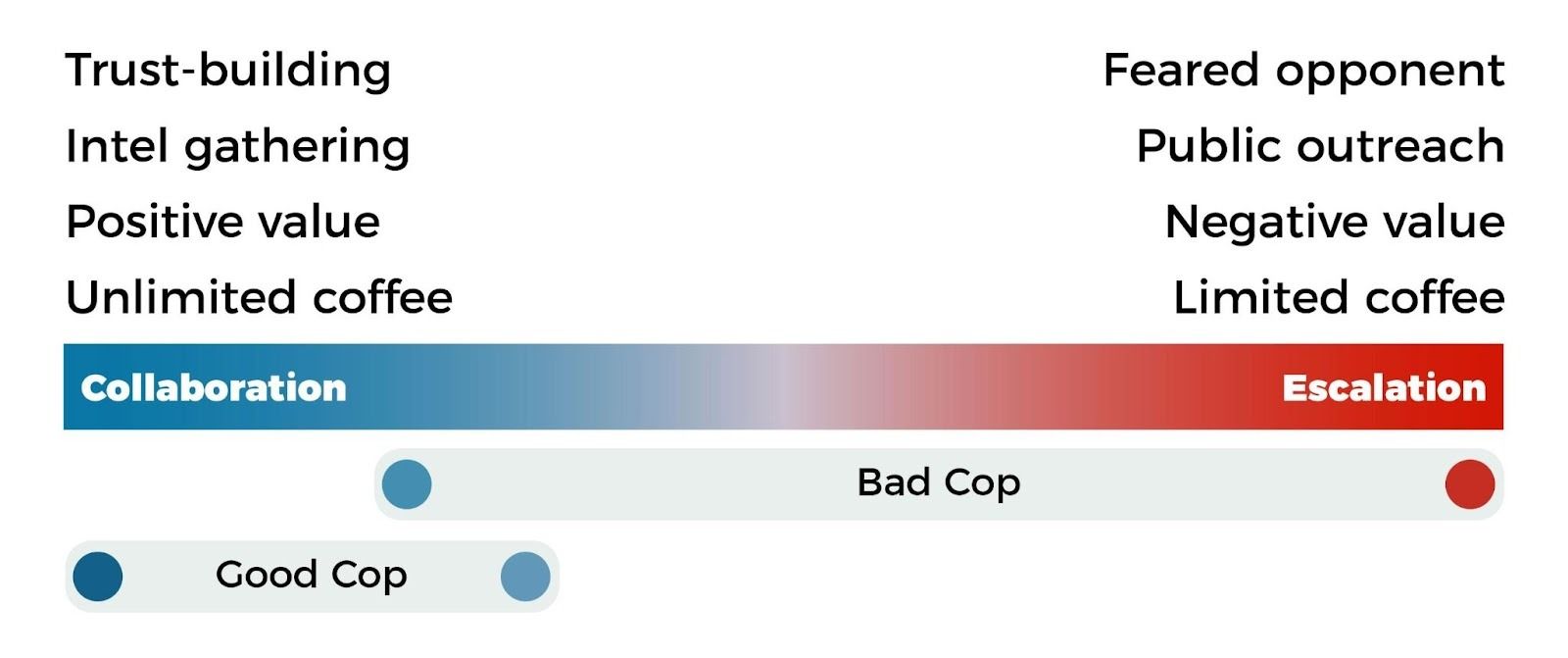
You could say that, together, the good cop and the bad cop cover the whole range between ‘collaboration’ and ‘escalation’ – so, if both cops are at work, we should have the best of both worlds. While this may be true in theory, it rarely works like this in practice.
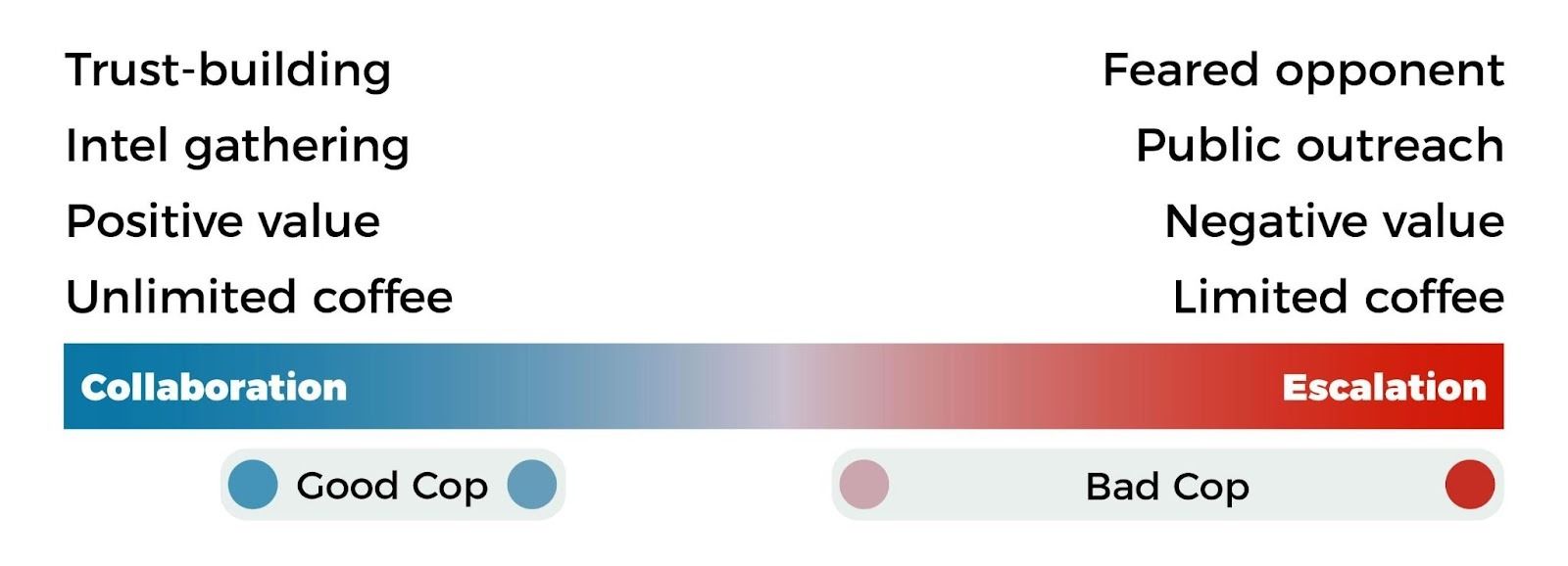
When two separate entities are at work, several limiting factors can set in. The company can, as often happens, decide that they will only engage with the good cop. The bad cop has been pushed to the streets. And, because the good cop is a good cop, there may be limits to how much pressure they can apply. If the good cop works too closely with the bad cop, they risk becoming tainted and being branded guilty by association. When trust erodes, information becomes scarcer or less truthful. The good cop has been wounded. These risks are the reason I’ve assigned the good cop a shorter range than the bad cop.
Another issue relates to coordination costs. If the good cop and the bad cop are working together, a lot of alignment work may be required, and disagreements around strategy or tactics can also arise.
So we’re left with gaps in our range – i.e., some tactics are never explored because both cops face constraints on their ability to act and collaborate. It might look like this:
Finally, there’s something important to be said about psychological discomfort and authenticity. For many people, being locked into either a “good” or “bad” stance can feel uncomfortable. As a good cop, you may feel frustrated that you have to maintain good relations even when you know companies are playing you – yet you’re limited in what you can do to push back. As a bad cop, it may feel forced or rushed to raise the prospect of negative campaigning from early meetings, before any relationship has been established. In both cases, people may end up conforming to predefined roles rather than responding authentically to the situation in front of them. Either consciously or unconsciously, campaigners may feel increased stress and behave in less authentic ways when they try to conform to their roles. I believe this reduced authenticity leads to worse conversations, and thus to worse results.
So what if there was a different approach that combined most of the benefits of the two traditional cops, while allowing campaigners to work in a more curious, unconstrained, direct, and authentic fashion?
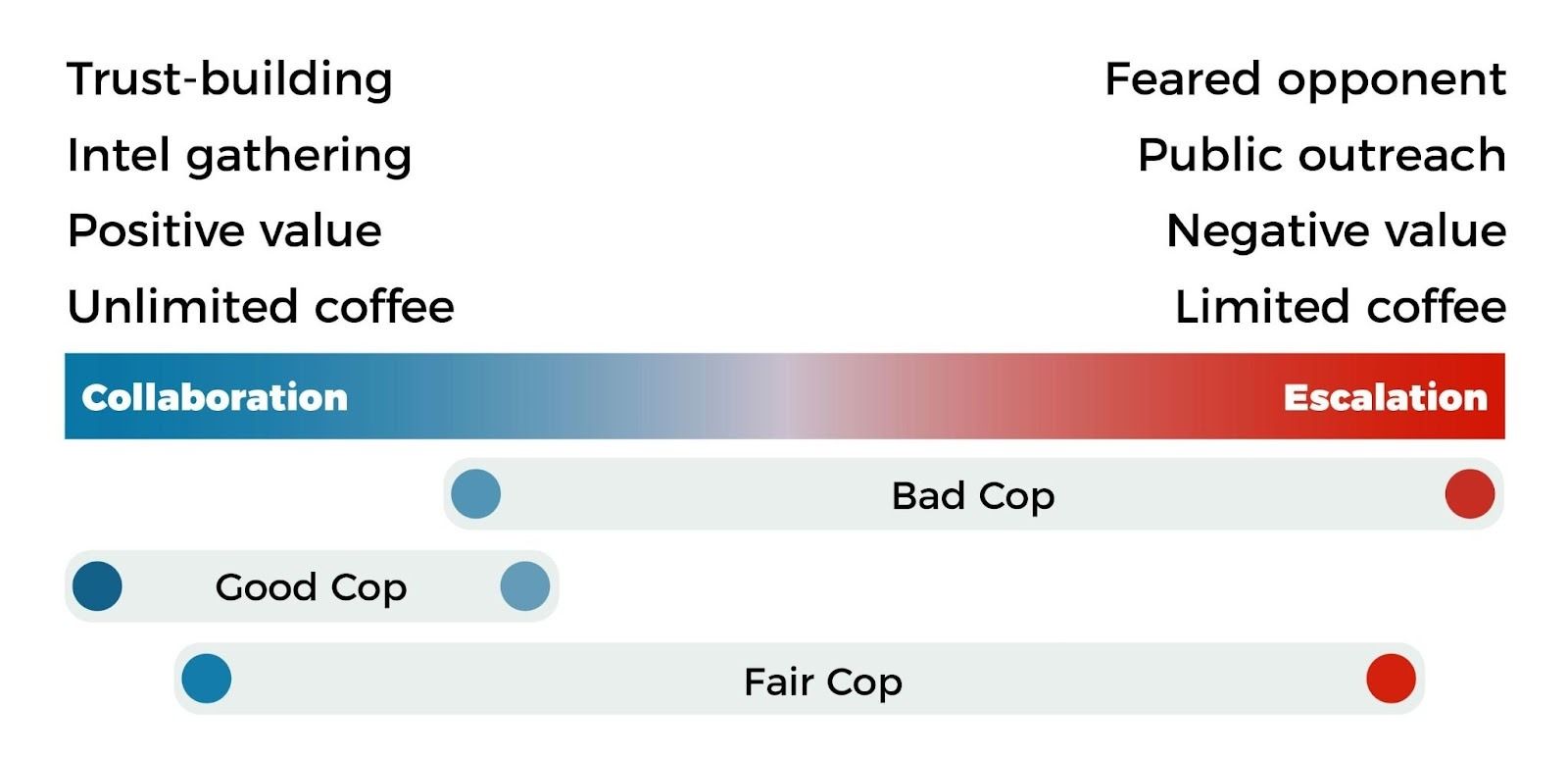
This is where “fair cop” is needed and why it – in my view – shines. Here’s a simple way to illustrate the working range of the fair cop:
Whether it’s helpful to stick with the cop analogy, I’m not entirely sure. The point I want to make is that there is a way to do corporate work that allows for much more flexibility than the traditional roles.
The reason I chose to call it ‘fair’ is because my general rule is to assume the best of every new company that I meet. Even when I know there’s a 97% chance that the company is unwilling to take any action, I try to speak to that remaining 3% of possibility and see if I can bump it up to double digits. People who have worked in this field will know that things are rarely sorted after one or two meetings with a company. Building trust and understanding each other's challenges takes time, and I believe that a good negotiator should be interested not only in the company but also in the company representative that they are engaging with. The more you can connect on a professional – or sometimes even personal – level, the clearer a picture you’ll be able to gain.
I’m becoming a stronger believer in applying fair play principles to corporate outreach. This includes:
This is not a fully formed framework – rather, it’s an intuitive approach I’ve developed through practice. I guess you could also call it the ‘authentic approach’. I think it would look somewhat different depending on who was performing this work.
While we would all love to live in a world where you could simply state a problem and its solution and have the papers signed soon thereafter, this is rarely how things work in practice. Often, two, three, or even seven meetings have taken place, and the results are clearly not forthcoming. You then decide that public campaigning is the natural next step.
I know some people advocate for “surprise attacks”, but I generally believe that a more transparent approach comes out on top in the long run. I know there are good arguments for hitting by surprise; however, when campaigners are consistently fair, it is much harder for a company to claim public sympathy. If you are playing with open cards, you may even be able to add pressure on a company by making them aware of your escalation plans. And when a campaign has been going for a while, there are still many possibilities for surprises, as there’s no expectation that you’ll inform the company of every tactical move that you make.
Once a campaign has been launched, the odds of building sustained meaningful dialogue go down. But if you have spent time building the relationship and you have been honest and transparent about your next steps, I’d say chances are still quite good that dialogue can be maintained at a useful level.
The fair cop knows that launching a campaign is no small feat, so whenever it can be avoided, it should be.
No single approach wins on all fronts. As shown in Figure 3, the fair cop’s range does not go as far to the left as the good cop’s, and not as far to the right as the bad cop’s. When you are a fair cop who can do both coffee drinking and pressure campaigning, there will be times when companies do not want to meet with you. For example, running a campaign at all might be a dealbreaker for some companies. That is why the good cop’s range stretches a bit further to the left than the fair cop’s – because it’s only very rarely that a company will want to cut ties with a good cop.
Similarly, because the fair cop wants to optimize for maintaining continued dialogue, their range on Figure 3 does not stretch as far to the right as the bad cop’s. The fair cop will tend to set certain boundaries to avoid breaking with fair play. Targeting executives with protests at their homes could be one such limitation.
In practice, I find that the fair cop usually starts at the collaborative end of the range, but as time passes, they gradually move towards escalation as it becomes justified.
Let me share an example. Our organization had been asked to join a campaign targeting a large company that was not fulfilling its cage-free policy. We decided that our first step would be to reach out to the company to share our concerns and offer our help. After some time, we got hold of a company representative who wanted to meet. We were advised by campaigning groups that the best course of action would be to strongly criticise the company for its continued failure to act, and ideally to state that we were preparing to join the campaign with full force.
I was not prepared to work this way, as it would run counter to the fair cop approach, which I believe is often the most effective. Once the heat has been turned up in a negotiation, I find that it becomes difficult to de-escalate. If someone you don’t know starts talking about ramping up conflict, the natural response is to lower your trust in that person and become more defensive or strategic – and then the potential for real negotiation will have been crippled substantially.
Instead, we showed up at the meeting (online) with an open mind and some general talking points about our concerns and our understanding of the history of the company’s cage-free policy. We had a very pleasant meeting with their representative, who talked a lot about himself and his story, and the many animal-related issues the company is engaging with. It was an interesting conversation. Only a fraction of the meeting was spent on “what can we do from here”, but what matters is that we got to that point along the way. We ended up deciding that we should organize a meeting with the decision-maker in the company. After three meetings in total, the company went from ignoring campaigners to wanting to engage and see if a path forward could be found. I feel confident that, had we followed the bad cop path of boasting about how powerful we are and our preparations to launch a large campaign, our contact would have concluded that we are just like all the others and politely ignored us after the first meeting. And more importantly, we would have missed out on a lot of important information about the company and decision makers.
I should mention that we did not refrain entirely from talking about campaigning; we transparently stated that we had been asked to join the campaign and that this was something we were considering. This was said in a neutral, matter-of-fact way, and not to give the impression that we were trying to scare them into submission. This is what I mean by ‘being authentic’. We were being ourselves as much as we could, with as few scripted talking points as possible.
Several months after those first meetings, a resolution was found between the company and the groups who had led the effort from the start. It is clear that this was only a part of a much larger effort, and that the campaign was won through the sustained work of many others. But this intervention established some new diplomatic ties that helped pave the way towards a resolution.
The ’good cop bad cop’ framework has been around for many years in the space of corporate policy work. While the simplicity of the concept is appealing, and it encompasses some meaningful ways of approaching corporate outreach, I believe it also often locks us into scripted ways of working. It can come across as almost theatrical that campaigners must behave as either someone who enjoys sitting at the table and listening, or someone who single-mindedly condemns a company’s practices and lack of action. I think the flexibility afforded by the fair cop approach is not being utilised enough, and it’s probably not fully understood yet, either.
This piece offers a starting point for seeing its usefulness, and it is my hope that many more people will take this approach seriously and continue to improve it. I feel that I still have much to learn about how to take this work to the next level, and I’m optimistic that the animal protection movement can further develop it in a collaborative fashion.
I will end by going back to Henry Spira and leave you with his 10 points of how to have success for animals copied from Peter Singer’s book Ethics Into Action: Henry Spira and the Animal Rights Movement:
1. Try to understand the public’s current thinking and where it could be encouraged to go tomorrow. Above all, keep in touch with reality.
2. Select a target on the basis of vulnerabilities to public opinion, the intensity of suffering, and the opportunities for change.
3. Set goals that are achievable. Bring about meaningful change one step at a time. Raising awareness is not enough.
4. Establish credible sources of information and documentation. Never assume anything. Never deceive the media or the public. Maintain credibility, don’t exaggerate or hype the issue.
5. Don’t divide the world into saints and sinners.
6. Seek dialogue and attempt to work together to solve problems. Position issues as problems with solutions. This is best done by presenting realistic alternatives.
7. Be ready for confrontation if your target remains unresponsive. If accepted channels don’t work, prepare an escalating public awareness campaign to place your adversary on the defensive.
8. Avoid bureaucracy.
9. Don’t assume that only legislation or legal action can solve the problem.
10. Ask yourself: “Will it work?”
If you feel like negotiating with the biggest companies is something you either would like to explore or you have experience (maybe you work in one!), please write to me directly – ts@anima.dk
Acknowledgements:
Jakub Stencel, Felipe Hickmann, Kirsty Henderson, Jan Sorgenfrei, Niels Vogensen, Ania Kozłowska
Thorbjørn ‘Toby’ Schiønning has over 15 years of experience in corporate engagement and campaign work with Anima International. He has engaged directly and indirectly with hundreds of companies and secured commitments and implementation from a large proportion of them. The topics have mainly been broilers, cage-free, and fur. He has largely been guided by trial and error, intuition, and sincere curiosity. Toby is an avid player of chess, poker, and backgammon, which has probably influenced the way he approaches his work.

